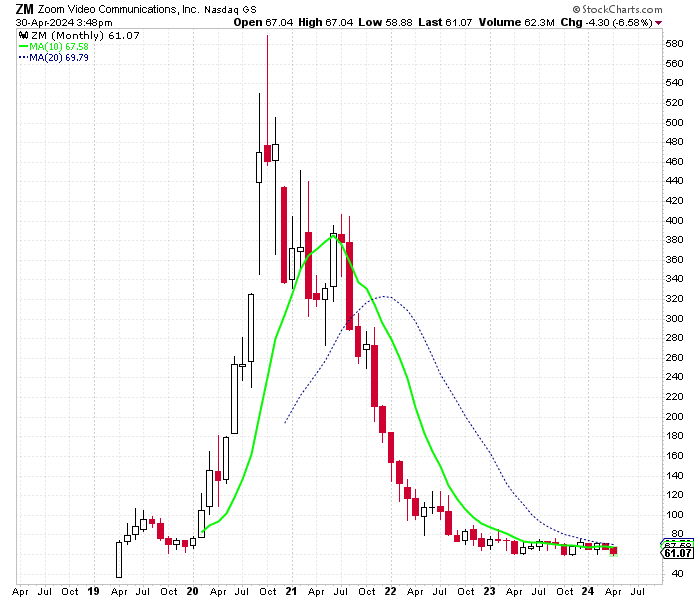
Morgan Stanley's AMZN, TSLA, NFLX and ZM Contingent Income Auto-Callable Securities
Have you ever come across financial products with strange names and promises of hefty returns? If you've encountered CUSIP numbers like 61771E5N4, 61771VAB6, and 61771VB90, there's a good chance they represent contingent income auto-callable securities (CIACS). Now, before you get swept away by the possibility of big payouts, let's dissect these seemingly complex financial instruments and unveil the potential dangers lurking beneath the surface.
Intriguing Idea, Intricate Reality
On paper, CIACS sound like an appealing concept. They offer the potential to earn a higher income stream compared to traditional bonds. The "contingent" part signifies that the payouts are linked to the performance of a specific underlying asset, like a basket of stocks. The "auto-callable" feature means the issuer has the right to redeem the security early if certain conditions are met.
Sounds like a potential win-win, doesn't it? Well, not quite. Here's where the complexity unfolds. It is possible to lose big in this type of investment and not receive any coupons!
The Hidden Thorns: Understanding the Risks
Early Redemption Risk: Remember the auto-call feature? It can abruptly end your investment, potentially before you receive any significant payouts. Imagine getting called early when the stock prices are high, but missing out on future gains if they climb even higher.
Missed Opportunity Cost: Early redemption can also lock you out of potentially better investments. If interest rates rise, you might be stuck reinvesting your principal at a lower rate.
The Price Barrier: To receive those contingent income payouts, the combined price of the underlying assets, like the AMZN, TSLA, NFLX, and ZM in the examples you mentioned, usually needs to stay above a specific level on predetermined dates. If the combined price dips below this "barrier," you miss out on income entirely.
Downside Protection...Maybe: Some CIACS offer a degree of protection if the underlying assets experience a significant decline. However, this protection usually applies only to the principal amount you invested, not the potential income you were hoping for.
The Devil in the Details: What the CUSIP Numbers Don't Tell You
Those cryptic CUSIP numbers only represent a small part of the story. The real details lie within the prospectus, the legal document outlining the specific terms of the security. Understanding these details is crucial before investing in CIACS. Here are some key aspects to pay close attention to:
Call Schedule: When can the issuer call the security? Knowing this helps you assess the potential duration of your investment.
Coupon Barrier Level: What combined price of the underlying assets needs to be met for you to receive a payout?
Downside Protection Mechanism: How much protection does the security offer if the underlying assets crash?
Don't Be Blinded by the Potential Yield
CIACS often dangle high potential yields to entice investors. But remember, high yields often come with high risks. Before getting caught in the trap of these complex investments, consider your risk tolerance and investment goals. If you're looking for a safe, predictable income stream, CIACS might not be the answer. FINRA recommends heightened supervision of complex products.
Seek Professional Guidance
If you're still curious about CIACS, consult a qualified financial advisor. They can help you understand the specific terms, risks, and suitability of these investments for your portfolio. Don't let the allure of high yields cloud your judgment. Remember, with complex investments like CIACS, knowledge is truly power.
If you or a loved one bought continent income securities and were misled please call 1-888-760-6552 to speak to an attorney. Soreide Law Group handles these cases in all 50 states before FINRA.
What investors should know about leveraged tax-loss harvesting, short positions, fees, and suitability. Tax-aware long-short investing can be presented as a sophisticated way to generate capital losses and reduce current taxes. But it is not merely a tax-planning overlay. It is an active, leveraged investment strategy that can produce substantial economic losses, high carrying costs, […]
Investors may have suffered financial harm by securities broker David Andrew Kangas [CRD: 6591398, Richmond, Virginia], given the public information found on Financial Industry Regulatory Authority (FINRA) BrokerCheck. Kangas has worked for WealthForge Securities LLC since November 1, 2019. Keep reading to find out more about Kangas’s disclosures. WealthForge Investor Accused Kangas Of Breach Of […]
Financial Industry Regulatory Authority initiated a complaint against securities broker Keith Charles Moore [CRD: 5191450, Irvine, California], based on public information on BrokerCheck. Moore worked for Sutter Securities Clearing LLC from August 24, 2017, to February 16, 2024, and Sutter Securities Incorporated from April 17, 2019, to February 16, 2024. Continue reading to learn more […]
Contact us Nationwide USA
2401 E. Atlantic Blvd., Suite 305, Pompano Beach, FL 33062