Madison Avenue Securities shows up on BrokerCheck beside a pending customer arbitration naming Wesley Palmer (CRD 6433982). The product at issue is a BDC or interval fund. The allegations are unproven, and no party has paid anything on the claim.

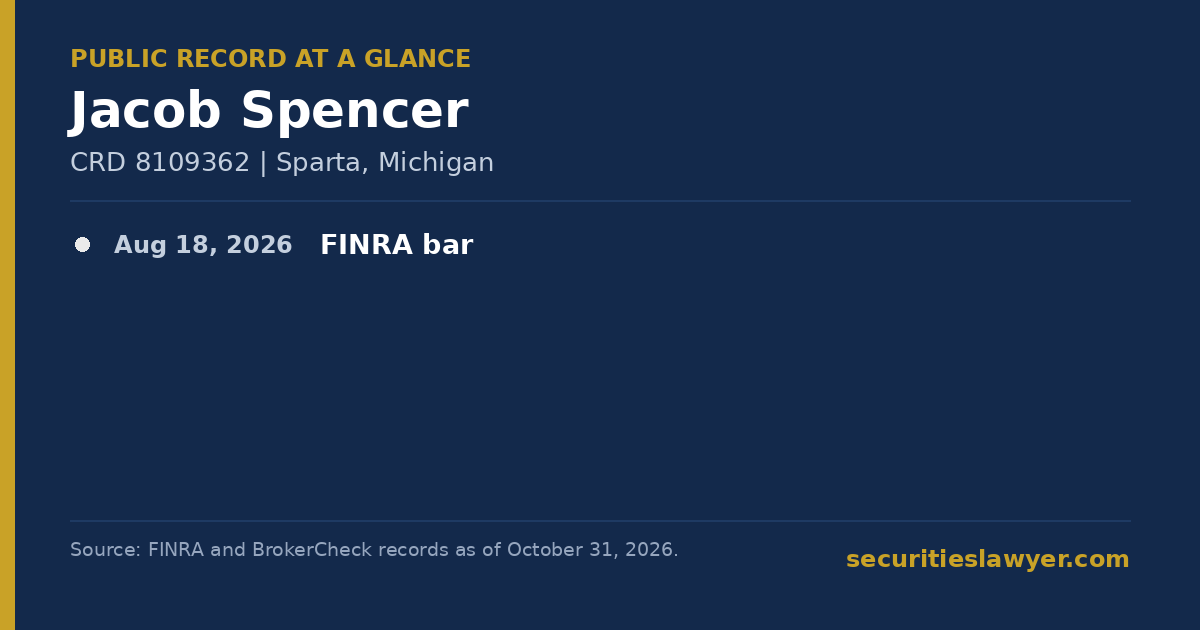
An AWC dated August 18, 2026 ended with a FINRA bar for Jacob Spencer (CRD 8109362) of Sparta, Michigan. The case concerned his conduct on the Series 6 exam.
FINRA found that Jacob Spencer used internet-enabled eyeglasses to access test material and cheat on the exam. Spencer consented to the findings without admitting or denying them.
The test's full name is the FINRA Investment Company and Variable Contracts Products Representative Examination. FINRA gives it to people who want to sell certain fund and insurance products.
According to the AWC, Spencer attested before the exam that he had read the relevant Rules of Conduct. He also attested that he would abide by them.
Those rules kept examinees from using prohibited items. The findings name electronic devices and eyewear with any electronic modification. The only exception was a FINRA approved accommodation.
The Series 6 covers investment company and variable contract products. In practice, that means mutual funds, variable annuities and variable life insurance. Candidates also pass a general industry knowledge exam before they can register.
A passing score is how FINRA confirms that a representative knows these products. That is why test centers screen for devices, and why the exam sits at the center of the Jacob Spencer case.
BrokerCheck lists the exams a representative has passed and the registrations he or she has held. It also shows disclosures such as regulatory actions.
When we look at a broker's record, the exams section is one of our first stops. A gap between the exams passed and the products sold deserves a question. Investors can search Jacob Spencer by name or CRD number.
FINRA barred Spencer from association with any FINRA member in all capacities. The AWC carries FINRA Case #2026089830701.
Under FINRA's arbitration code, a claim generally has to be filed within six years. The clock starts with the event that gave rise to the claim, often the purchase or the last recommendation. State statutes of limitation may also apply, and some are shorter than six years. Those limits are why an investor who suspects a problem should act rather than wait for the account to recover. The first step is to gather the account statements and the confirmations. We review them free of charge and explain whether a claim can still be filed.
FINRA member firms must supervise the activities of their brokers. If you have questions about an account that Jacob Spencer handled, call Soreide Law Group at (888) 760-6552. You can also reach us online to speak with a securities attorney. FINRA arbitration is a national forum, so we represent investors in FINRA arbitration across the country. We handle these claims on a contingency fee basis. Learn how FINRA arbitration works.
This post summarizes public FINRA records, including BrokerCheck, as of October 31, 2026. In a FINRA Letter of Acceptance, Waiver and Consent, the respondent settles without admitting or denying the findings. FINRA may also update or correct these records after that date.
Madison Avenue Securities shows up on BrokerCheck beside a pending customer arbitration naming Wesley Palmer (CRD 6433982). The product at issue is a BDC or interval fund. The allegations are unproven, and no party has paid anything on the claim.
FINRA entered findings against Matt Ward (CRD 2075525) over his trading authority in customer accounts. He consented without admitting or denying them. BrokerCheck also lists settled customer disputes at Alliance Global Partners and Euro Pacific Capital.
A variable annuity and life insurance are the products in a pending claim against Deborah Key (CRD 1236421). Its allegations are unproven, and no money has been paid on it.
Phone:
Fax: 1-954-760-6553
Email: [email protected]