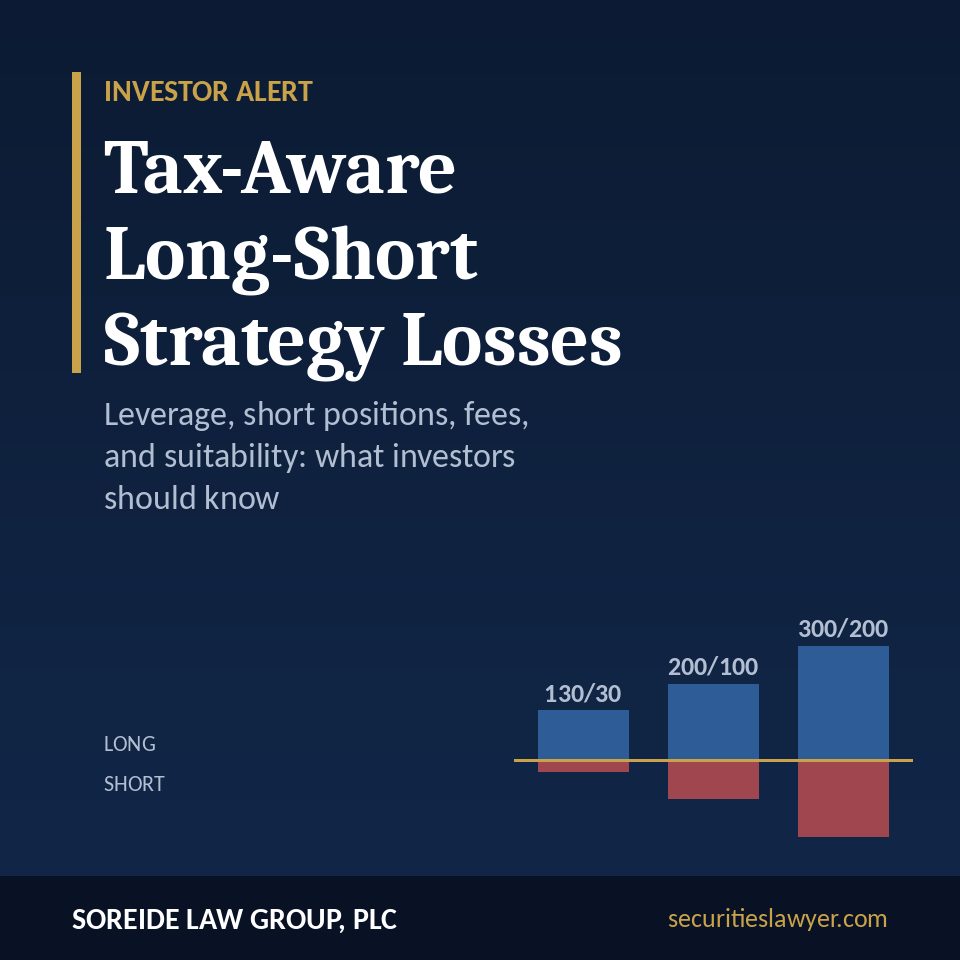
Did a Tax-Aware Long-Short Strategy Cause Significant Investment Losses?
What investors should know about leveraged tax-loss harvesting, short positions, fees, and suitability.
Tax-aware long-short investing can be presented as a sophisticated way to generate capital losses and reduce current taxes. But it is not merely a tax-planning overlay. It is an active, leveraged investment strategy that can produce substantial economic losses, high carrying costs, margin pressure, and long-term tax complications.
Soreide Law Group, PLC is investigating potential claims by investors who experienced significant losses after being placed in tax-aware long-short strategies, long-short direct indexing programs, leveraged tax-loss harvesting accounts, or separately managed accounts described as 130/30, 200/100, 300/200, or similar strategies.
An investment loss does not by itself establish misconduct. The central questions are whether the strategy was suitable for the investor, whether its leverage and short-selling risks were fairly explained, whether costs and conflicts were disclosed, and whether the account was supervised and managed in the investor’s best interest.
How Tax-Aware Long-Short Strategies Work
A traditional tax-loss harvesting program sells investments that have declined below their tax basis and reinvests the proceeds while attempting to maintain market exposure. A tax-aware long-short strategy goes further. The manager may borrow cash to buy additional long positions and borrow securities to establish short positions. The strategy seeks to harvest losses on individual positions while using gains elsewhere in the portfolio to maintain overall exposure.
The labels describe gross exposure. A 130/30 portfolio generally holds long positions equal to 130 percent of the investor’s net capital and short positions equal to 30 percent. A 200/100 portfolio may hold 200 percent long and 100 percent short. The account may therefore have far more money at risk than the amount the investor initially contributed.
Tax Losses Are Not the Same as Economic Losses
A statement may highlight millions of dollars in “tax losses generated.” That number does not prove the investor benefited. A harvested tax loss can defer tax by offsetting a capital gain, but it often lowers the basis of replacement holdings and may shift the tax liability into the future. Its value also depends on whether the investor has gains that can actually use the loss, the applicable tax rate, the holding period, and the ultimate liquidation plan.
The economic result is different: what happened to the investor’s net account value after market gains and losses, borrowing costs, securities-lending charges, advisory fees, trading costs, and taxes? The portfolio can generate a tax asset while simultaneously losing real money. Industry commentary has expressly warned that these strategies can produce asymmetric economic losses and that carrying costs create a meaningful performance hurdle. [1]
How Real Losses Can Occur
Risk
How it can harm the investor
Short positions rise
A short position loses when the borrowed security increases in price. Unlike a long position, the theoretical loss on a short sale is unlimited.
Long and short selections diverge
The long book can lag while the short book rallies. The two sides are not perfect offsets because the portfolio must take genuine investment risk.
Leverage magnifies mistakes
Gross exposure can reach two, three, or more times the investor’s net capital, amplifying stock-selection errors and volatility.
Costs consume returns
Management fees, margin interest, stock-borrow charges, trading costs, and taxes can require substantial alpha merely to keep pace with a simpler portfolio.
Margin pressure forces action
Adverse moves can create collateral demands, forced sales, or liquidation at unfavorable prices.
The exit creates another problem
Closing the strategy or liquidating appreciated replacement positions can reveal deferred gains and a larger-than-expected tax bill.
A Simple Illustration
Consider a hypothetical investor who contributes $10 million to a 200/100 strategy. The manager establishes $20 million of long positions and $10 million of short positions. If the long book gains 8 percent but the short book rises 25 percent against the investor, the account’s simplified pre-cost result would be:
Component
Calculation
Result
Gain on $20 million long book
$20m × 8%
+$1,600,000
Loss on $10 million short book
$10m × 25%
−$2,500,000
Simplified economic result before costs
−$900,000
If a $10 million benchmark gained 10%
+$1,000,000
Gap versus the benchmark before costs
−$1,900,000
This hypothetical example is intentionally simplified. Actual damages analysis should use the account’s daily positions, cash flows, tax returns, fees, financing charges, borrowing costs, and an appropriate benchmark. It illustrates why “tax losses generated” cannot substitute for measuring total economic performance.
Warning Signs in a Tax-Aware Long-Short Strategy
The strategy was marketed primarily as a tax solution, with little discussion of active stock selection, leverage, short selling, or the possibility of large economic losses.
The investor was told the strategy was market neutral, low risk, index-like, or designed to protect capital without a balanced explanation of how the account could underperform.
Reports emphasized harvested losses or “tax alpha” but did not clearly show net account performance, benchmark underperformance, financing charges, and all-in fees.
The investor lacked sufficient capital gains to use the losses, had a short time horizon, needed liquidity, or could not tolerate margin risk.
There was no practical exit plan explaining what would happen when the strategy was unwound, including the potential realization of deferred gains.
The account experienced a margin call, forced liquidation, unexpectedly large short-position loss, or sharp decline during a market rally.
The adviser or firm failed to monitor whether the promised tax benefit continued to justify the strategy’s increasing costs and risks.
When Tax-Aware Long-Short Strategy Losses May Support a Claim
Depending on the facts, potential claims may involve an unsuitable recommendation, misleading statements or omissions, failure to disclose leverage and short-sale risks, failure to explain costs and conflicts, breach of fiduciary or best-interest duties, negligent supervision, or failure to monitor and recommend an appropriate exit. The analysis is highly account-specific. A poor result alone is not enough; the communications, disclosures, investment profile, trading records, and supervision history matter.
Most claims against a broker-dealer are resolved through FINRA arbitration rather than in court. Understanding that process in advance can help investors decide whether and how to pursue a claim.
Documents to Preserve
Monthly statements, performance reports, tax-loss reports, trade confirmations, and realized gain and loss schedules.
Emails, text messages, meeting notes, presentations, proposals, and marketing materials describing the strategy.
Tax returns and communications with accountants showing whether losses were used and what tax was actually deferred or saved.
Records of margin calls, cash contributions, forced sales, strategy termination, and any tax liability created by the unwind.
How to Measure Tax-Aware Long-Short Strategy Losses
A meaningful review should compare the investor’s actual ending wealth with a reasonable alternative that reflects the investor’s objectives and risk tolerance. The calculation should account for contributions and withdrawals, realized and unrealized investment results, advisory and manager fees, margin interest, stock-borrow expenses, trading costs, taxes actually avoided or deferred, and taxes expected when the strategy is unwound. Any claimed tax benefit should be measured in dollars and timing, not simply by the face amount of harvested losses.
If you lost a substantial amount of money in a tax-aware long-short strategy, leveraged tax-loss harvesting program, or long-short separately managed account, Soreide Law Group, PLC can review the recommendation, disclosures, account activity, costs, and supervision. Investors who experienced margin calls, forced liquidation, unexpected short-side losses, severe benchmark underperformance, or a costly unwind should preserve their records and contact our firm for an independent legal review. Call 1-888-760-6552
This article is for general informational purposes only and is not legal, investment, or tax advice. Every matter depends on its facts. Prior results do not guarantee a similar outcome.
Sources
Kitces.com, "Tax-Aware Long-Short Investing: Not Just a Tax Overlay, But a Risk-Managed Active Investment Strategy," June 17, 2026.
AQR, "Experience Matters: Addressing Five Common Criticisms of Tax-Aware Long-Short Strategies," May 27, 2025.
What investors should know about leveraged tax-loss harvesting, short positions, fees, and suitability. Tax-aware long-short investing can be presented as a sophisticated way to generate capital losses and reduce current taxes. But it is not merely a tax-planning overlay. It is an active, leveraged investment strategy that can produce substantial economic losses, high carrying costs, […]
Investors may have suffered financial harm by securities broker David Andrew Kangas [CRD: 6591398, Richmond, Virginia], given the public information found on Financial Industry Regulatory Authority (FINRA) BrokerCheck. Kangas has worked for WealthForge Securities LLC since November 1, 2019. Keep reading to find out more about Kangas’s disclosures. WealthForge Investor Accused Kangas Of Breach Of […]
Financial Industry Regulatory Authority initiated a complaint against securities broker Keith Charles Moore [CRD: 5191450, Irvine, California], based on public information on BrokerCheck. Moore worked for Sutter Securities Clearing LLC from August 24, 2017, to February 16, 2024, and Sutter Securities Incorporated from April 17, 2019, to February 16, 2024. Continue reading to learn more […]
Contact us Nationwide USA
2401 E. Atlantic Blvd., Suite 305, Pompano Beach, FL 33062