Madison Avenue Securities shows up on BrokerCheck beside a pending customer arbitration naming Wesley Palmer (CRD 6433982). The product at issue is a BDC or interval fund. The allegations are unproven, and no party has paid anything on the claim.

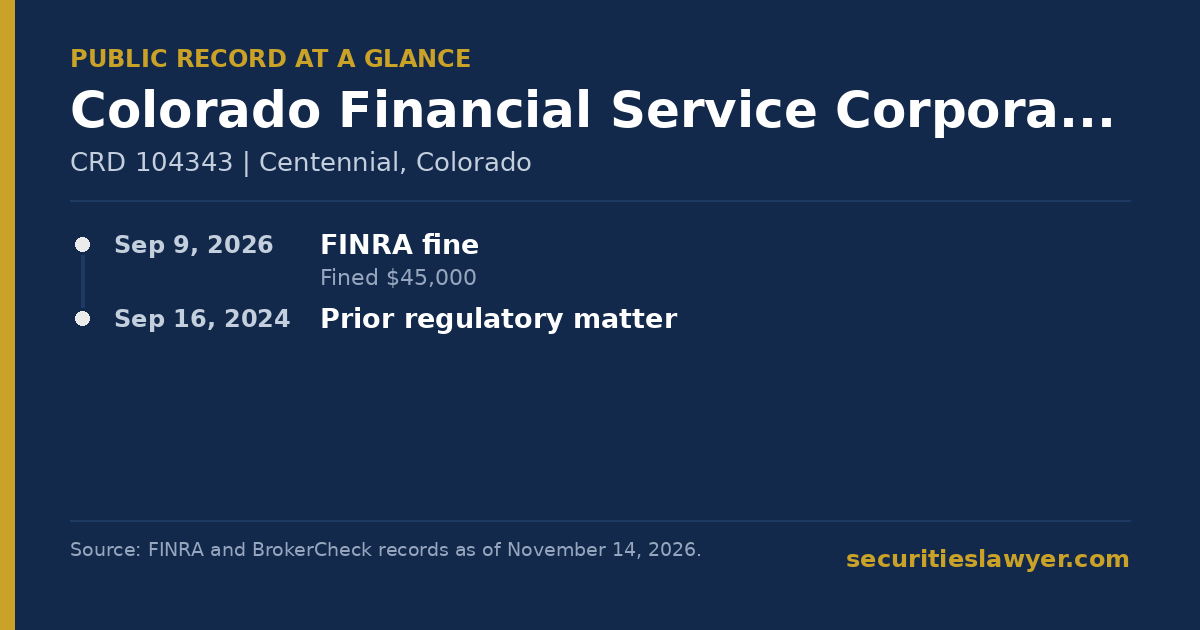
Centennial, Colorado firm Colorado Financial Service Corporation (CRD 104343) settled a FINRA case over closed-end fund sales. The AWC, dated September 9, 2026, carries FINRA case number 2023077597702.
Without admitting or denying the findings, the firm consented to them and to a censure, a fine and customer restitution. FINRA found it failed to reasonably supervise CEF recommendations under Reg BI.
The AWC describes a former firm registered representative and a senior retail customer of Colorado Financial Service. She had a moderate risk tolerance and low income. The representative recommended a series of investments in seven different CEFs that held below-investment grade securities.
Prospectuses for those funds described them as high-risk or speculative. The representative recommended that she put 100 percent of her stated net worth into the CEFs, and the findings record losses of $29,049.
FINRA found that the firm missed red flags, including the gap between her risk tolerance and the funds' stated risk levels. FINRA later fined and suspended the representative, among other sanctions. Those sanctions concerned CEF recommendations that were not suitable or in customers' best interest.
The findings also cover a non-retail customer, a trust for an educational entity with low risk tolerance. The same representative recommended that the trust invest 100 percent of its stated net worth in one of the high-risk CEFs.
The trust's new account form showed the CEF position as 100 percent of its assets. Even so, Colorado Financial Service did not detect the red flags of that concentration or the mismatch in risk.
A closed-end fund raises a set pool of money and then trades on an exchange like a stock. Its market price can sit above or below the value of what it owns.
Many of these funds borrow to boost income. The ones that buy below-investment-grade debt add credit risk on top of that leverage, and when markets fall, both effects can hit at once.
When we review a CEF claim, we look first at how much of the account sat in funds with the same strategy. This is general background and adds nothing to the Colorado Financial Service AWC.
BrokerCheck lists an earlier Colorado Financial Service matter dated September 16, 2024, case 2020066831101. Without admitting or denying the findings, the firm consented to findings about its AML procedures. FINRA found they lacked a reasonable design to detect and report suspicious transactions, including potentially manipulative activity such as prearranged trading.
The procedures said the firm would manually monitor enough account activity to spot unusual patterns. However, they did not say how often that monitoring would happen.
For the CEF matter, FINRA censured Colorado Financial Service Corporation and fined it $45,000. FINRA also ordered the firm to pay $29,049, plus pre-judgment interest, in restitution to a customer.
Regulation Best Interest is an SEC rule in effect since June 2020. When a broker-dealer makes a recommendation to a retail customer, the rule requires it to act in that customer's best interest. The firm and its representative also may not place their own interests ahead of the customer's.
An account is overconcentrated when too much of it sits in one stock, one sector or one type of product. If that position drops, the whole account drops with it. A broker's recommendations have to fit the customer's investment profile. That profile includes age, other holdings, risk tolerance, liquidity needs and time horizon. As a result, a large position that suits one investor can be wrong for a retiree who needs steady income. When we review a claim like this, the account statements usually tell the story. They show how big the position grew and how long it was held.
Brokerage firms have a duty to supervise the brokers who work for them. If Colorado Financial Service handled your account and you have questions, Soreide Law Group can go over it with you. Call (888) 760-6552 or contact us online. Because these claims go to FINRA arbitration rather than a local court, we handle them for investors nationwide. We work on a contingency fee basis. Here is how FINRA arbitration works.
This post summarizes public FINRA records, including BrokerCheck, as of November 14, 2026. In a FINRA Letter of Acceptance, Waiver and Consent, the respondent settles without admitting or denying the findings. FINRA may also update or correct these records after that date.
Madison Avenue Securities shows up on BrokerCheck beside a pending customer arbitration naming Wesley Palmer (CRD 6433982). The product at issue is a BDC or interval fund. The allegations are unproven, and no party has paid anything on the claim.
FINRA entered findings against Matt Ward (CRD 2075525) over his trading authority in customer accounts. He consented without admitting or denying them. BrokerCheck also lists settled customer disputes at Alliance Global Partners and Euro Pacific Capital.
A variable annuity and life insurance are the products in a pending claim against Deborah Key (CRD 1236421). Its allegations are unproven, and no money has been paid on it.
Phone:
Fax: 1-954-760-6553
Email: [email protected]