High yield bonds are the subject of a settled Morgan Stanley dispute on the BrokerCheck report of Joseph Stern (CRD 2994501). A settlement is not an admission of wrongdoing.

High yield bonds are the subject of a settled Morgan Stanley dispute on the BrokerCheck report of Joseph Stern (CRD 2994501). A settlement is not an admission of wrongdoing.
A high yield bond comes from an issuer with a credit rating below investment grade. The issuer pays more interest because lenders see more risk of default.
Prices can fall sharply when the issuer's business weakens or when markets turn. Rising interest rates also push bond prices down. Some issues trade thinly, so selling quickly can mean taking a lower price.
When we review a bond claim, we look at what share of the account sat in lower-rated debt. The product named in the Joseph Stern dispute is this kind of bond.
A misrepresentation claim over bonds usually turns on what the broker said about safety. Describing a lower-rated bond as safe, or as similar to a bank deposit, can draw this kind of complaint.
Investors can check the rating, the maturity and the issuer on their own confirmations and statements. A settled complaint like the one on Joseph Stern's report records the allegation, not a finding.
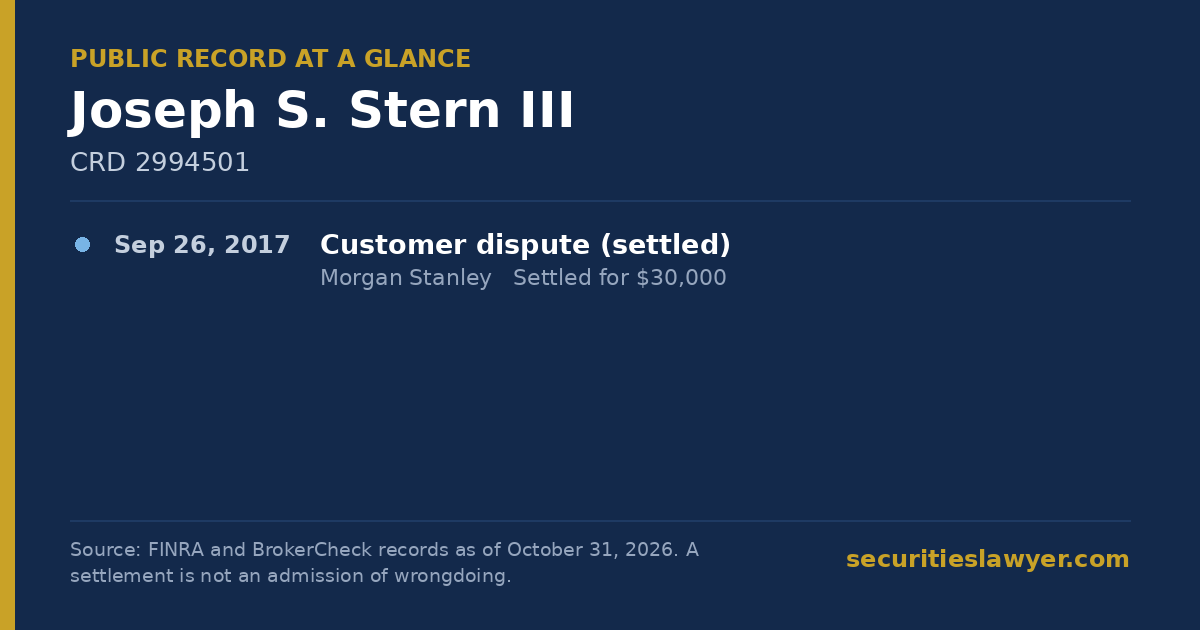
Morgan Stanley received the complaint on September 26, 2017, according to BrokerCheck. The client alleged misrepresentation with respect to the risk inherent in the purchase of high yield bonds. The allegations cover 2012 to 2017, and the client left alleged damages unspecified.
The dispute settled for $30,000. Joseph Stern's report lists the product as Corporate / High-Yield Bond.
Most disputes between investors and brokerage firms go to FINRA arbitration, not court, because the account agreement requires it. The first step is the investor's statement of claim, which sets out what happened and what is owed. The brokerage firm and the broker then answer the claim in writing. Next, the parties pick a panel of one or three arbitrators from lists FINRA provides. After that comes discovery, where each side exchanges account records and other documents. Many claims settle before a hearing is held. Those that do not are decided by the panel in a written award. FINRA makes arbitration awards public. A settlement is not published as an award, so its amount appears only on the broker's BrokerCheck report.
Brokerage firms have a duty to supervise the brokers who work for them. If Joseph Stern handled your account and you have questions, Soreide Law Group can go over it with you. Call (888) 760-6552 or contact us online. Because these claims go to FINRA arbitration rather than a local court, we handle them for investors nationwide. We work on a contingency fee basis. Here is how FINRA arbitration works.
This post summarizes public FINRA records, including BrokerCheck, as of October 31, 2026. Allegations in customer complaints and arbitrations are claims, not findings. A settlement is also not an admission of wrongdoing. FINRA may also update or correct these records after that date.
High yield bonds are the subject of a settled Morgan Stanley dispute on the BrokerCheck report of Joseph Stern (CRD 2994501). A settlement is not an admission of wrongdoing.
A claimant seeking $2,000,000 in a pending FINRA arbitration has named Louis Tucci (CRD 4508379) over a DST / 1031 Exchange investment. Realta Equities is the firm on the disclosure. The allegations are unproven, and Tucci has answered them on BrokerCheck.
A 2010 customer complaint at Eagle Strategies over a 457(b) rollover names Eric Heiting (CRD 3052881). The complaint centered on a retirement plan move and its tax effect, and it ended in a settlement.
Phone:
Fax: 1-954-760-6553
Email: [email protected]